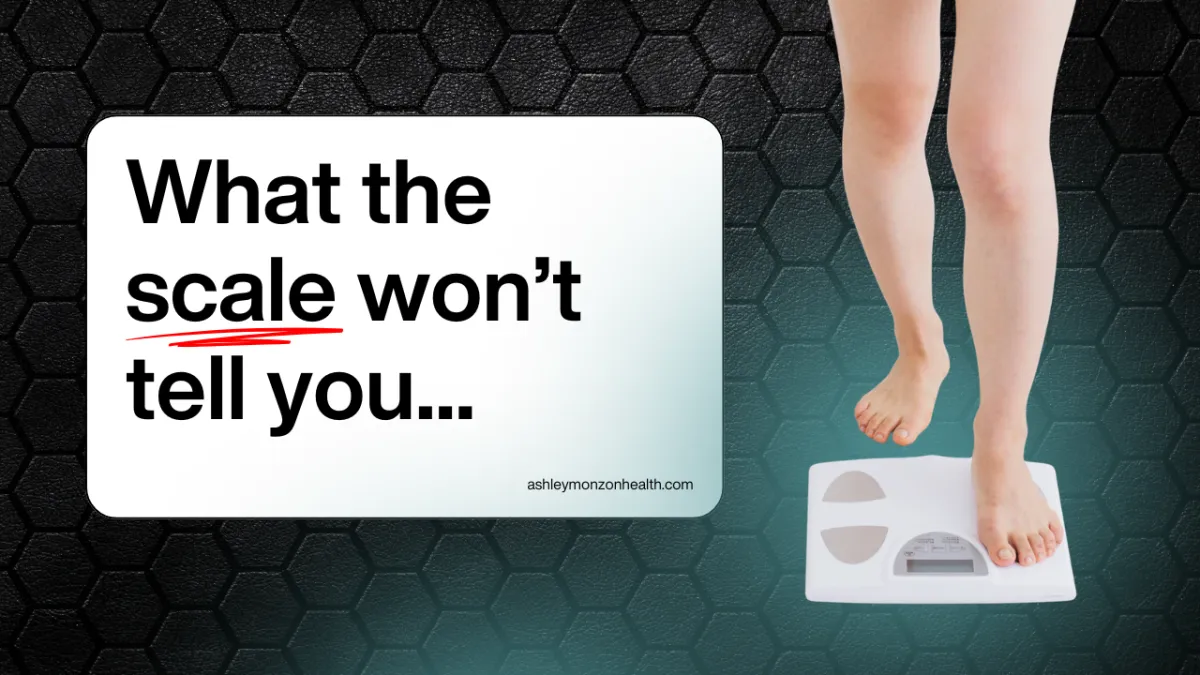
The Scale Isn’t the Scoreboard
The scale can be loud.
It flashes one number at you and suddenly it feels like a verdict. Good day. Bad day. On track. Failing.
But here’s the truth:
The scale measures weight.
It will not measure progress.
And those two are not the same thing.
You’ve Probably Lived This Before
You wake up feeling good. You’ve been consistent. You’re drinking more water. You’re moving your body. Your clothes feel a little looser. You’re sleeping better. Your mood is steadier.
Then you step on the scale.
And the number hasn’t moved.
Or worse—it’s up.
Instantly, your brain tries to rewrite the story:
“Maybe this isn’t working.”
“Maybe I need to try harder.”
“Maybe I’m doing it wrong.”
But here’s what’s wild: your body can be getting stronger, healthier, and more regulated… while the scale stays the same.
Or even goes up.
What About Smart Scales?
Now you might be thinking, “Okay, but what about smart scales? They show body fat and muscle."
And yes — smart scales can give you more data than weight alone.
Most at-home smart scales use something called bioelectrical impedance. In simple terms, they send a tiny electrical signal through your body and estimate body fat, muscle mass, and water levels based on how that signal travels.
The catch?
Hydration alone can shift those numbers.
If you’re:
On your cycle
Slightly dehydrated
Holding onto sodium
Recovering from a workout
Stressed
Your body fat percentage reading can change — even if your actual fat mass hasn’t.
Smart scales aren’t bad. They’re tools.
But they still don’t measure your metabolic health.
And That’s the Bigger Picture
Metabolic health is about how well your body actually functions.
It’s how efficiently you:
Regulate blood sugar
Use insulin
Produce energy
Recover from stress
Build and maintain muscle
You can lose weight and still struggle metabolically.
You can maintain weight and dramatically improve your metabolic health.
And here’s the part most women don’t hear enough:
Many of the habits that improve metabolic health don’t cause dramatic, overnight scale drops.
They look like:
Strength training consistently
Eating adequate protein
Sleeping 7–8 hours
Walking daily
Managing stress
Staying hydrated
These habits improve insulin sensitivity, lower inflammation, and support muscle growth — all of which make your metabolism more resilient over time.
The scale may not reward you immediately.
But your body is adapting in powerful ways behind the scenes.
If you’re curious where your metabolic health currently stands, I created a simple quiz you can take here: 👉 Metabolic Health Quiz
Sometimes awareness is more empowering than another weigh-in.

What Progress Actually Looks Like
Real progress is quieter.
It looks like:
Doing push-ups on your toes when you couldn’t before.
Having steady energy through the afternoon.
Not crashing into the pantry at 9pm.
Feeling calmer in stressful moments.
Showing up for workouts even when you don’t feel like it.
Choosing balance instead of all-or-nothing.
Progress shows up in performance.
In energy.
In consistency.
In resilience.
And those things compound.
When your identity shifts to “I’m someone who takes care of myself,” the physical results follow—but they’re not the only marker anymore.
The Trap of Outsourcing Your Worth
When we rely only on the scale, we outsource our sense of success to something that doesn’t even understand context.
The scale doesn’t know:
That you went for a walk instead of quitting.
That you made a protein-packed breakfast.
That you’re sleeping an extra hour.
That you’re managing stress better.
That you’re building muscle.
It just reports gravity.
You are more than a number.
Your discipline is more than a number.
Your effort is more than a number.
Your growth is more than a number.
And your health? It’s far more complex and intelligent than a digital screen can capture.
If You Still Want to Use the Scale…
You can. It’s not evil.
But use it as one data point—not the decision maker.
Zoom out. Look at trends over weeks, not days. Pair it with how you feel, how you perform, and how consistent you’ve been.
And if it messes with your head more than it helps you? It’s allowed to take a break.
This Week, Try This
Instead of obsessing over the number, track one non-scale win.
Just one.
Maybe it’s:
Drinking 80 ounces of water.
Hitting three workouts.
Adding vegetables to dinner.
Going to bed 30 minutes earlier.
Feeling less bloated.
Feeling more confident in your clothes.
Write it down. Celebrate it.
Because momentum builds from recognition.
And when you start measuring the right things, you’ll realize something powerful:
You’ve been making progress all along.